
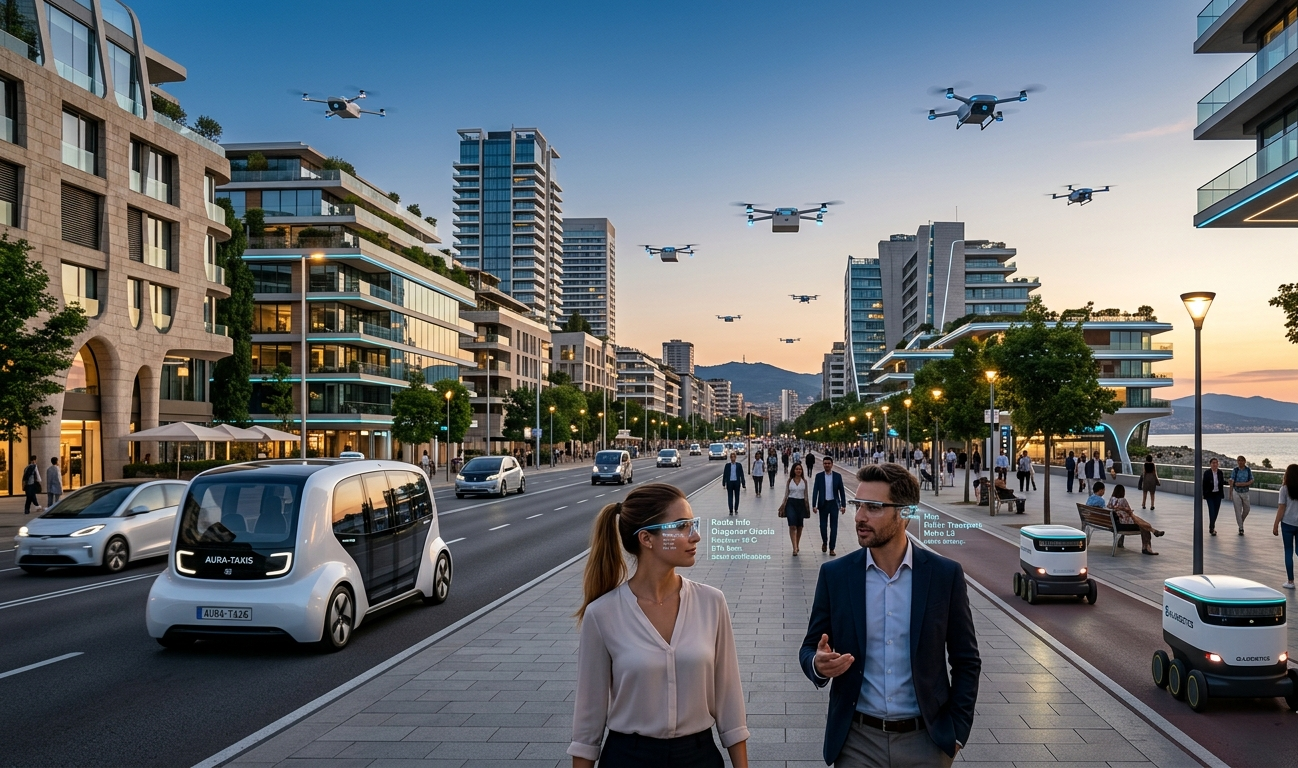
In 2026, artificial intelligence is no longer just a digital phenomenon. It has become a tangible force reshaping the physical world. Europe is at the center of this transition with the rise of what is now called Physical AI: intelligent systems capable not only of analyzing data, but also of interacting with, executing, and transforming real-world environments autonomously and with high precision.
This shift represents a historic turning point comparable to the Industrial Revolution or the rise of computing—but with a fundamental difference: intelligence is now embedded directly into matter.
What Exactly Is Physical AI?
Physical AI is the convergence of several advanced technologies:
– Advanced artificial intelligence (multimodal models, vision, language, reasoning).
– Autonomous robotics.
– Real-time sensor networks (advanced IoT).
– Physical control systems (movement, manipulation, navigation).
In simple terms, Physical AI is AI that can see, decide, and act in the real world without constant human intervention.
Unlike traditional AI—focused on text, predictions, or data analysis—Physical AI introduces execution capability: moving robotic arms, driving vehicles, delivering packages, or assisting in surgical procedures.
Europe as a Regulated Laboratory for Physical AI
Europe is not leading this revolution through speed, but through structure, governance, and regulation.
The European Artificial Intelligence Act (AI Act) establishes a legal framework for classifying risk levels, supervising high-impact systems, and ensuring transparency in sensitive environments.
Alongside this, Europe is investing heavily in:
– Digital Europe initiatives.
– Advanced industrial automation strategies.
– Robotics and cyber-physical systems.
– Edge computing infrastructure.
This creates a unique ecosystem: slower in deployment than other regions, but more stable and structurally integrated in the long term.
The Four Pillars of the Physical AI Revolution in 2026
1. Robots in Logistics, Manufacturing, and Healthcare
Automation is evolving into contextual autonomy.
In logistics, robots no longer just move goods—they optimize routes, predict demand, and coordinate with each other in real time.
In manufacturing, flexible production systems allow factories to be reconfigured in hours instead of weeks.
In healthcare, assistive robots are increasingly used for:
– Internal transport of materials.
– High-precision surgical support.
– Mobility assistance for patients.
2. Expansion of Autonomous Vehicles
Robotaxis and advanced autonomous vehicles are moving from experimentation to controlled deployment.
In Europe, adoption is cautious but growing through pilot programs:
– Autonomous driving zones in restricted environments.
– Driverless logistics corridors.
– Semi-autonomous public transport systems.
The main challenge is not technology, but regulation and urban integration.
3. Autonomous Drone Networks
Drones are becoming part of automated aerial infrastructure.
Key applications include:
- Medical supply delivery in critical areas.
- Energy infrastructure inspection.
- Environmental and urban monitoring.
- Emergency response support.
The major breakthrough in 2026 is coordinated autonomy, where fleets of drones operate as unified systems rather than isolated units.
4. Real-Time AI Smart Glasses
AI-powered augmented reality glasses represent the most personal interface of Physical AI.
They enable:
– Real-time environmental translation.
– Contextual assistance for technical tasks.
– Assisted navigation.
– Hands-free information access.
This effectively turns AI into an invisible layer over reality.
Economic and Social Implications
Physical AI does not simply automate tasks—it reshapes the relationship between humans and operational environments.
Key impacts include:
– Reduction of repetitive and hazardous work.
– Restructuring of industrial and logistics employment.
– Significant productivity gains across critical sectors.
However, it also introduces new challenges:
– Dependence on autonomous systems.
– Cybersecurity risks in physical infrastructure.
– Technological inequality between regions.
– Europe’s Central Dilemma.
The core European debate is not whether Physical AI is possible, but how autonomous it should be.
The tension lies between:
- Economic efficiency.
- Public safety.
- Meaningful human control.
The balance between these forces will define Europe’s global technological position.
Conclusion
Physical AI marks the definitive shift of artificial intelligence from the abstract digital space into the physical world. Europe, with its regulatory and structural approach, is not just participating in this transformation—it is actively shaping its foundations.
In 2026, innovation is no longer measured only by algorithms, but by their ability to directly transform the physical reality in which we live.